
How to Find Your YouTube Niche Without 6 Months of Overthinking

I have talked to dozens of aspiring creators over the past two years. Roughly half of them have been "working on figuring out their niche" for longer than six months. In that same time period, they uploaded zero videos. The niche question is not a planning problem. It is a procrastination problem dressed up as a planning problem.
That said, "just start" is only half the right advice. Starting in the wrong direction wastes real time - not six months of overthinking time, but real months of content production, community building, and algorithm training. A niche pivot at 50 videos means 50 videos that no longer fit your channel. That is a material cost.
So here is the practical middle ground: spend a weekend on this, apply a real framework, and move. Not perfect. Moved.

Niche selection is a decision, not a discovery. You commit to a direction and iterate from there.
What a niche actually is on YouTube
A niche is not a topic. Fitness is not a niche. Coding is not a niche. Food is not a niche. Those are industries with hundreds of millions of videos each. Competing in an industry without differentiation is how you get 47 views after a year of work.
A YouTube niche is the intersection of three things:
- Your knowledge or passion - what you know well enough to explain clearly and sustain for two years
- An audience's recurring problem or desire - something people actively search for, repeatedly, not just once
- A format that works on the platform - tutorial, review, documentary, commentary, whatever maps to how the topic is best consumed
When all three overlap, you have a niche. When two of three overlap, you have a hobby or a business but not necessarily a channel that grows.
The traps
Too broad. "Tech" is 500 million videos. "Personal finance" is 200 million. These are not competitive in the normal sense - they are saturated at the general level and wide open at the specific level. If your plan is to make general tech videos, you are competing with Marques Brownlee and Linus Tech Tips for attention on day one. You are not going to win that fight as a new channel.
Too narrow. "Vegan keto sourdough for apartment dwellers over 40 in the Pacific Northwest" has specific appeal to approximately 340 people. YouTube's algorithm needs enough search volume to find an audience for you. A niche that is too thin means YouTube cannot surface your videos because there are not enough people searching for the topic consistently. Keyword research tools like Ahrefs can show you estimated monthly YouTube search volumes - if a term gets fewer than 500 searches per month, the niche is probably too thin to build on.
The practical target: a niche specific enough that you have a clearly defined viewer in mind, broad enough that you can make 100 videos without running out of material.
The right question isn't "what should I make?" It's "who specifically benefits from me making this?" A person, not a demographic. One viewer, not an audience.
The longevity test
Right now, without any research, write down 10 video ideas for your candidate niche. Not good titles. Just concepts. Can you do it in under 10 minutes?
If yes, you probably have enough genuine knowledge and interest to sustain the niche. If you stall at four or five ideas, that is a signal. Either the niche is too narrow, or you are not as interested in it as you thought. Both are useful to know now rather than at video 30.
vidIQ's niche research guide recommends a minimum of 50 viable video ideas before committing to a niche. I think 10 in 10 minutes is a good enough early gate. The rest you will discover through research and making the first few videos.
The intersection approach
This is the most reliable framework I know for finding a viable niche quickly. Answer three questions and look for the overlap:
- What do you know well? Not what you are passionate about - what can you explain clearly without preparation? "I could teach someone the basics of X in an afternoon" level of knowledge.
- What do people actually search for? Use Google Trends and YouTube's autocomplete to find out what real people type into the search bar. The autocomplete is a direct readout of what the audience wants.
- What are existing competitors bad at? Search for three or four videos on your candidate topic. Are they slow? Jargon-heavy? Outdated? Too long? If you can clearly identify how you would make it better or different, that is your angle.
The intersection of all three is your starting niche.
A real example: "coding tutorials" is too broad. But "coding for non-technical founders" is a specific intersection of programming knowledge, an audience of people (startup founders) with a specific recurring problem (they need to understand what their engineers are doing), and a gap in the market (most coding tutorials assume technical intent, not managerial intent). That channel can make 200 videos without blinking.

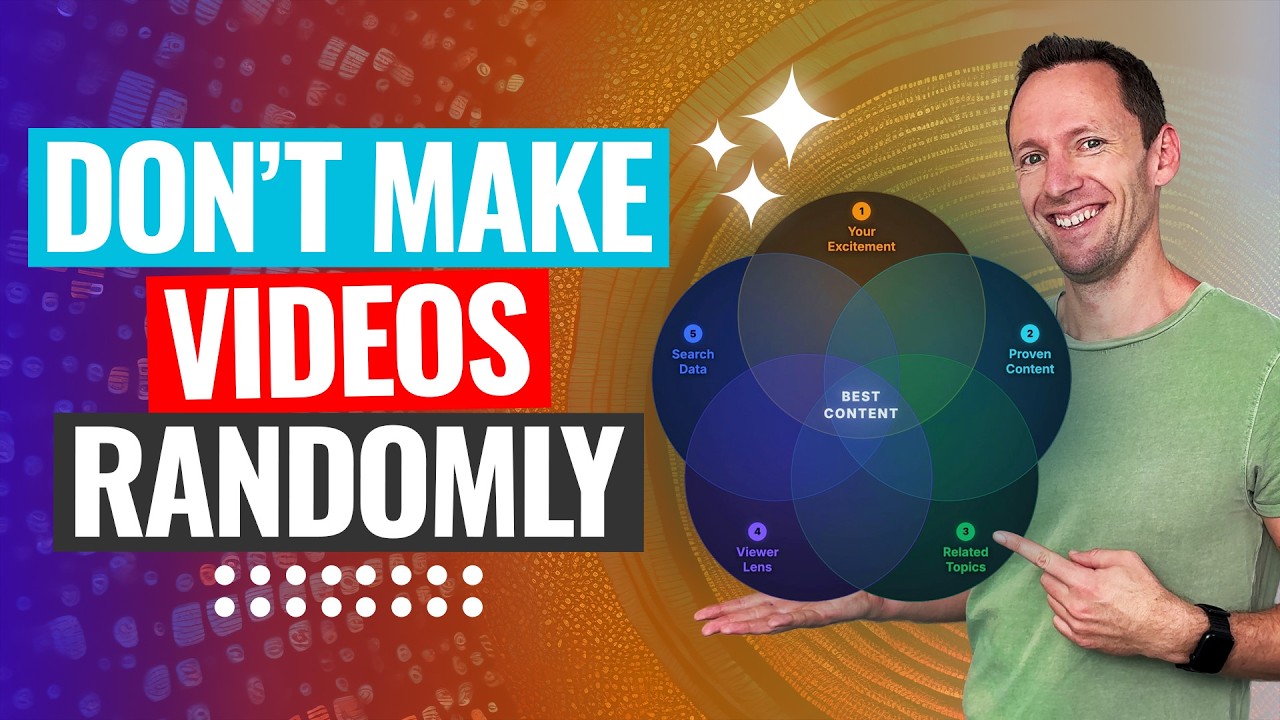
Map the three-way intersection on paper. Where your knowledge, your audience's problem, and platform demand overlap is where your channel lives.
The "just start" addendum
Here is where the standard YouTube advice is right but incomplete. "Just start" is correct in the sense that no amount of niche research substitutes for the feedback loop you get from actually making videos. Your first ten videos will teach you things about your audience that no spreadsheet will.
But "just start" without any directional clarity means you will make ten videos on five different topics, confuse the algorithm, confuse your viewers, and end up with a channel that has no coherent identity. YouTube's own guidance emphasizes consistent topic focus as a core growth driver. A channel that bounces between topics signals to the algorithm that it cannot predict what the next video will be about, which reduces recommendation frequency.
So the actual advice is: start with a clear enough intent that you can describe your channel in one sentence. Not a perfect plan. Not a locked niche. A sentence. Then make ten videos, watch what happens, and adjust.
Your niche will evolve. That is fine and expected. But launch with a clear intent, not a vague one. The algorithm needs a map.
When to pivot
Your niche will evolve. That is not a failure - it is how every successful channel works. YouTube's creator research consistently shows that the top-growing channels shift their specific focus over time as they learn what their audience actually responds to.
The signal to consider a pivot is data, not boredom. If your view-to-subscriber ratio is declining on a specific topic type, if comments are asking for something adjacent to what you make, if a different video format dramatically outperformed your standard format - those are signals. Boredom after three months is not a signal. That is just the normal experience of building something that takes time.
A niche pivot is expensive if you are at 50 videos. It is cheap if you are at five videos. The earlier you identify a misalignment, the lower the cost. Which is why watching your analytics from video one matters more than most creators admit. The data is available from the start. Most people do not read it.
Once you have your niche locked, your research workflow matters. YouTube Bookmark Pro's Library makes it easy to save competitor videos, tag them by topic, and build a reference database without losing tabs or context while you plan.
Further viewing
How two different creator-educators think about topic selection and niche - worth watching before you commit to a direction.

Join the conversation