
For Twenty Years, You Could Assume a Person Made It. Now a Small Grey Label Has to Tell You.

It was late, and I was doing the thing everyone does, half-watching one video while the next one loaded. And then under the player there was a line of small grey text I had not really registered before. Altered or synthetic content. Five plain words, sitting in the spot where the title and the view count used to be the only things that lived.
My first reaction was not alarm. It was a tiny, almost physical recalibration. The kind of pause you feel when a friend's voice on the phone sounds slightly off and, for half a second, you wonder who you are actually talking to. The label was not telling me the video was dangerous. It was telling me something quieter and stranger: that the question of whether a person had made this was now a question at all.
For about twenty years, it never was. You did not have to ask. You just assumed it.
The assumption nobody knew they were making
Think about what you took for granted every single time you opened YouTube. Not that the video would be good. Not that it would be true. Just that someone had been there. A person had pointed a camera, or opened an editor, or sat in a badly lit bedroom and decided this was worth saying. The face might be hidden, the voice might be processed, the whole thing might be wrong - but a human being was on the other end of it. That was the floor. That was the thing under everything else.
This morning Ethan walked through the mechanics of the change - how the disclosure label moved out of the description and up to a prominent spot directly below the player, how on Shorts it now sits as an overlay on the video itself, and the part that matters most: YouTube has started applying that label automatically. According to YouTube's own announcement on May 27, if its systems detect "significant photorealistic AI use" and the creator did not disclose it, the platform adds the label anyway - no permission asked. As 9to5Google put it, the label is now more visible whether the creator volunteered it or not, and TechCrunch confirmed two cases where it can never be removed at all: anything made with YouTube's own tools like Veo or Dream Screen, and anything carrying C2PA metadata that marks it as fully generated.
You can read all of that as a transparency feature, and it is one. But sit with the deeper thing it admits. A platform does not build a sign that says a person may not be here until it can no longer assume one is.
The label does not tell you the video is fake. It tells you that "a person made this" is no longer something you can take for granted.
We used to do this as a joke
Here is how recent the old world is. In 2021, Hank Green made an entire video pretending to be an AI version of himself. He called it Question Tuesday Except I'm an AI, answered real questions from real viewers in a flat robot cadence, and kept breaking the frame to remind everyone that the thing talking to them was not really him.
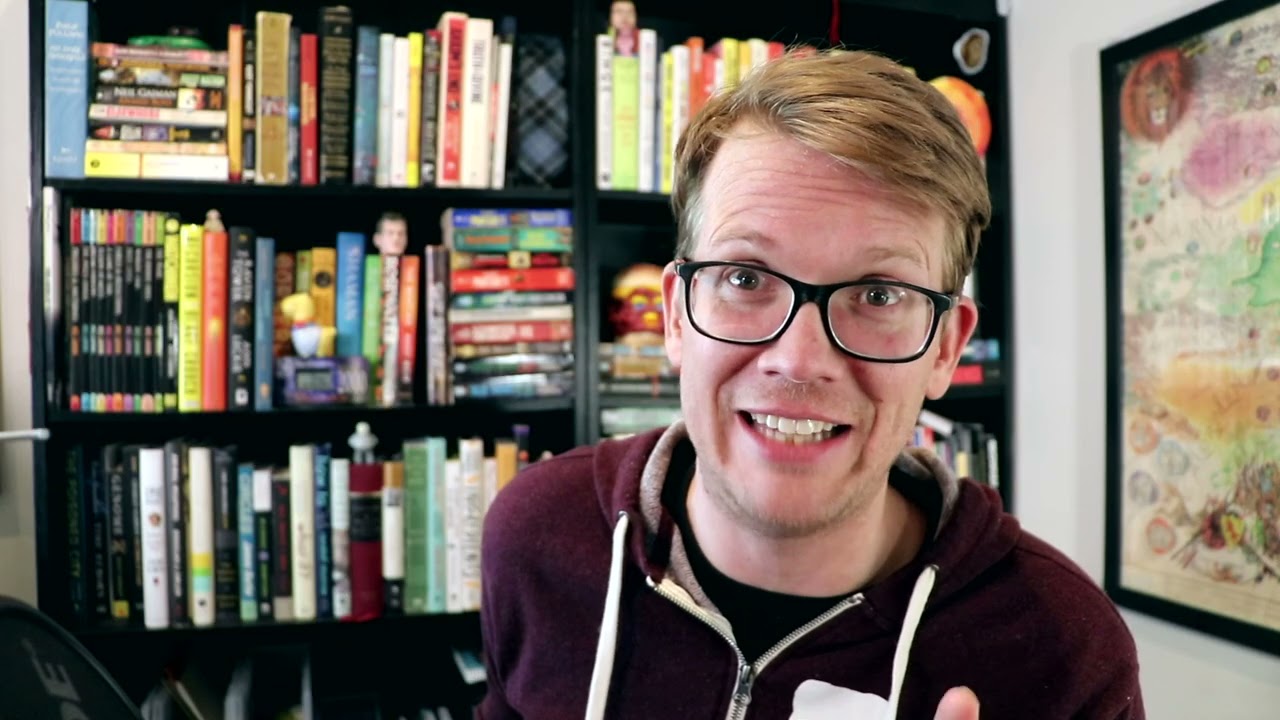
A human pretending to be a machine. In 2021 that was the joke. The whole point was that you could tell.
What makes it land now is the thing that made it funny then: the someone was loudly, warmly present the entire time. The bit only worked because the gap between Hank and a machine was so obvious you could play in it. He was performing the absence of himself for people who knew, with total certainty, that he was right there.
That certainty is what's gone. I wrote once about the channels where you never see a face and stay anyway - the LEMMiNOs and TierZoos, the explainer voices you would recognize in a crowd. The lesson of those channels was that "faceless" never meant "no one." There was always a person behind the voice, choosing every word. And in a piece about deepfakes I landed on a line I keep coming back to: the face was always the easiest part of trust. We were just lucky enough that, for a while, it was also true.
The channels where nobody is home
Then the math changed, fast. In December, a Kapwing study put numbers to a feeling a lot of us already had. On a brand-new YouTube account, more than one in five of the first videos the algorithm reaches for is AI slop - cheaply generated content built to farm watch time. Of the top hundred channels in every country, 278 of them contained only AI slop. Between them: more than 63 billion views, 221 million subscribers, and an estimated 117 million dollars a year.
Two hundred and twenty-one million subscriptions, pointed at channels with no one on the other end.
And the people who do operate them are open about what they are. Fortune profiled a 22-year-old grossing around 700,000 dollars a year from AI channels, his biggest earner a series of six-hour "documentaries" designed to play while the viewer is asleep. The content is not meant to be watched. It is not meant to be shared, or remembered, or loved. It is meant to trick the watch-time metric, because, as he put it, that is the number that pays. It is the precise opposite of a person sitting down to make something for another person.

A real creator, more than a decade on the platform, looking at his own feed and naming the feeling.
There's a name for the dread underneath this. The dead internet theory used to be a fringe idea - the claim that most of what you see online is no longer made by, or for, humans. It was easy to wave off. It is harder now. The unsettling part was never that the machines would lie to us. It was that so much would be produced for no one to feel anything about at all. The parasocial warmth I've written about so often - the sense that the person on screen is, in some small way, keeping you company - depends on there being a person. You cannot have a one-sided friendship with a watch-time funnel.
What the label can give back, and what it can't
So I went back and read the announcement again, slower this time, trying to be fair to it. And the honest answer is that the label does a real thing. When YouTube can tell that significant photorealistic AI was used, it now tells you, up front, in a spot you can actually see - and it tells you even when the uploader would rather you didn't know. For its own Veo and Dream Screen tools, and for files that arrive already stamped as generated, that flag is permanent. That is not nothing. A label you can read is worth more than a disclosure buried three clicks down in a description nobody opens.
But there is a column next to that one, and it is the column that keeps me up.
- A flag when significant photorealistic AI was used
- A heads-up before you decide whether to trust it
- The same marker even when the uploader stayed quiet
- A permanent tag on YouTube's own AI tools and C2PA files
- Tell you whether anyone is actually on the other end
- Restore the assumption you used to make for free
- Catch the soulless channel a single operator runs overnight
- Bring back the feeling of being spoken to by a person
That gap is the whole thing. The label marks a machine helped make this. It does not mark nobody here meant it for you. A six-hour sleep documentary stitched together by one person and a script generator might never trip the photorealism threshold, and so might never get a label at all - even though it is the emptier object. Meanwhile a painstaking, deeply human short film that used one AI-cleaned shot gets the badge. The label sorts videos by technique. The thing we actually want to know - is someone home - it cannot reach.
In 2019, before any of this, Tom Scott stood on a stage at the Royal Institution and gave a talk called There is No Algorithm for Truth. His argument was that no system can sort the true from the false for you, that the work of judgment cannot be handed off. Watching it now, it reads like a letter from a slightly more innocent internet.

A person on a stage, arguing for human judgment - years before the feed filled with things no human judged worth making.
There is no algorithm for truth, Tom Scott said in 2019. There is now an algorithm for "a machine helped make this." The harder question - did anyone mean it for you - still doesn't have a label.
A small grief, and a small kindness
I keep landing on the same two feelings about that little line of grey text, and they don't cancel out.
The first is a kind of grief. The label exists because the floor moved. For twenty years, "a person made this" was the free assumption underneath every click, and the label is the headstone for it. We will not get that assumption back. From now on it is a thing you check, not a thing you know.
The second is something gentler. The label is also the platform doing the one honest thing it can: when it can tell, it tells you. It will not always be able to. It will sometimes flag the wrong video and miss the emptiest one. But the impulse behind it - to hand a little of the judgment back to you, instead of letting the feed decide quietly - is the right one. It points the same direction Tom Scott did. The work of deciding what is worth your attention is yours, and it always was.
Which is maybe why I find myself, more than ever, wanting to hold onto the videos where someone is plainly home. The tutorial filmed by a person who clearly cared whether you understood. The channel whose voice you'd know anywhere. The video a friend sent because it made them think of you. Those are the ones worth saving, worth keeping somewhere you can find them again - because they are the ones with a person on both ends of the line.
The little grey label is not really there to warn you off the fakes. It's there to remind you to go looking for the ones where somebody is still on the other end. Waiting, the way they always were, to be found.
Join the conversation