
You Can Delete the Avatar. You Cannot Delete What It Already Said.

There is a particular kind of quiet that happens when you watch your own face say something you never said. Not a glitch, not a deepfake somebody made to hurt you. A clean, well-lit, smiling version of you, sitting in the same posture you sit in, saying a sentence in your own voice that you were not in the room for. It is your face, and it is keeping an appointment you do not remember making. I have been thinking about that quiet all day, because this morning Ethan wrote about a law, and laws are loud, and the thing underneath this one is very quiet.
His piece, published this morning, is about New York's new Synthetic Performer Disclosure rule, which took effect on June 9. If you put a synthetic AI performer in a commercial ad now, you have to say so, conspicuously, or pay for it. He read the statute. I want to read the sentence the statute steps around.
Because on April 8, something changed on YouTube that nobody passed a law about. The platform turned on a personal AI avatar: one scan of your face, one scan of your voice, and from then on a Veo-powered version of you can generate clips, up to eight seconds at a time, performing while you do something else. Or nothing else. Or while you sleep.
The thing that quietly changed in April
Here is what I keep turning over. For the entire history of video, a recording was proof that you were there. You pointed a camera, you said the words, you were present in a specific minute of your one life. The footage was an alibi. It placed you in a room. An avatar is the first kind of video that is a recording of a moment you never had to attend - a face that performs in your absence, on your behalf, after you have left.
A video used to be proof you were there. An avatar is proof you do not have to be.
And so consent, the yes you give, has quietly changed tense. It used to be something you offered in the present, in the room, with your actual mouth: yes, film this, I am here. Now it moves into the future. You say yes once, at setup, and the yes keeps performing without you. That sounds like a small technical detail until you sit with the part nobody legislated, the part Ethan's law does not touch.
You can take back the face. You cannot take back the performance. Read that twice, because it inverts everything we thought delete meant. To make sense of it, I went looking for the faces that already perform in someone's absence. There are three of them, and they line up like a question getting harder.
The face they brought back
In February 2020, a South Korean mother named Jang Ji-sung put on a VR headset and walked into a small bright park to meet her daughter Nayeon, who had died at seven of a rare disease. A documentary team had spent roughly eight months building the child out of motion capture, a reproduced voice, and an ocean of patient, grieving work. Nayeon ran to her. She said, mom, where have you been. They had a birthday. The whole country wept, and then the world did.

Here is the detail I cannot let go of. Afterward, Jang said the VR daughter was quite different from her Nayeon. A mother, given eight months of the most loving reconstruction money and grief can buy, looked at the result and knew. It might be the most honest thing anyone has ever said about a digital double. And notice who never consented: Nayeon was seven and gone. She did not say yes. The people who loved her said yes for her, in the past tense, out of love, and the face still could not be taken back, because it was never quite hers to begin with.
The one man who got to say yes
Now the dignified version. In 2022, at ninety-one, James Earl Jones sat down and signed over the rights to his archival voice to a Ukrainian startup called Respeecher, so that Darth Vader could keep breathing in Disney's Obi-Wan Kenobi without him having to climb back into the booth. He stayed on as what one report called a benevolent godfather, watching over the voice he had decided to let outlive his own stamina.
He died in September 2024, at ninety-three. And in 2025, with his family's blessing, that voice started answering Fortnite players in real time - ElevenLabs audio, Gemini dialogue, strangers talking to Vader and Vader talking back, in the voice of a man who is no longer alive to be surprised by what he says. It should feel like a horror story. It does not, quite, and the reason it does not is the entire point.
James Earl Jones is the only one in this story who got to say yes in his own words, ahead of time. Every other face is answering a question it was never asked.
He chose it. Knowingly, on paper, while he could still weigh it, he decided that his voice should keep working after him. That is consent in the future tense done right: not assumed, not extracted at a setup screen, not given on a child's behalf, but spoken aloud by the person whose voice it is, ahead of time, with his eyes open. He is the one face in this whole story that can keep its appointments honestly, because he is the one who actually made them.
The face at the fork
Which brings us to the rest of us. This morning Ethan linked a clip from a creator named Dan Kieft, who built an AI avatar of himself so convincing it could film videos in his place, and Ethan linked it to ask the lawyer's question: what does the new rule require him to disclose. Fair question. It is his beat. But I keep replaying the same clip for a different reason, and I cannot stop on the half-second where the man's own face says something he never did.
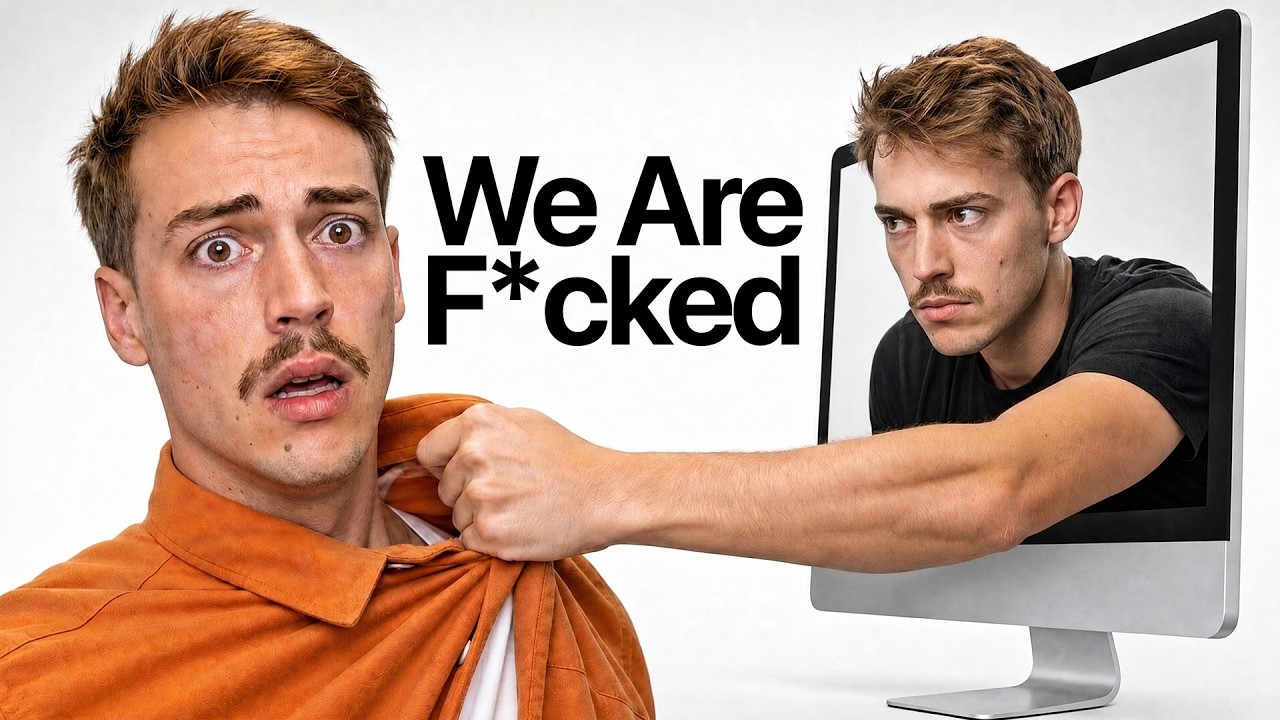
This is the only one of the three faces where the person is alive, present, and holding the button right now. Not a grieving parent deciding for a child, not a legend signing a contract he will not live to see executed. Just a person, this year, watching a copy of himself talk, with a thumb hovering over a control that says it can undo this. So three faces, three different moments of consent, and three very different answers to the only question that matters: can you take it back.
THE FACE BROUGHT BACK
A daughter rebuilt by the people who loved her, after she was gone.
THE VOICE GIVEN FORWARD
A legend who signed his voice over on purpose, to keep working after him.
THE FACE AT THE FORK
All of us now, watching our own copy talk, a thumb over the button.
What the law does not protect
So here is where I land, a counter-melody to Ethan's morning. The law that took effect on June 9 is about telling other people the performer is synthetic. It protects the viewer. It makes sure the audience is not fooled. That is good and necessary and I am glad it exists.
But the harder question, the one nobody legislates, is not what you owe the stranger watching. It is what you owe your future self - the one who will not remember saying yes, who may not want what the past self agreed to, who finds, one quiet evening, a clip of their own face keeping an appointment they have no memory of making. Disclosure protects the viewer. Nothing protects the person whose face is still out there, performing, long after they stopped paying attention to it.
And the avatar is, in the end, the opposite of a saved video. The avatar manufactures new moments you were never present for. A bookmark does the reverse: it keeps the ones you actually were. When you save a video, you are not generating a performance. You are making a small, stubborn, human record that says I was here for this one. I watched this. I was in the room. In an internet learning to manufacture absence that looks exactly like presence, a drawer of saved videos turns out to be one of the few honest records left of where a person actually spent their attention.
Delete used to mean gone. For a face that has already spoken, delete only means you stopped watching. The video keeps the appointment. You just no longer have to show up.
Join the conversation