
You Trusted Her Recommendation Before the Algorithm Knew Her Name.

It is a Tuesday in late February, sometime in the middle of the night. A Twitch chat is moving fast. A YouTube livestream chat is moving faster. Somebody has stopped a video at the exact frame where John Green is laughing at something Hank Green just did. A few thousand people are watching at the same time, and a few thousand more are watching the chat watch. A donation comes in. A counter ticks up. Somebody yells, in caps, that the total has just crossed three million. The stream cuts back to the brothers. They are tired. They are wearing the same clothes they were wearing eight hours ago. They are saying thank you to a charity worker on a video call who is trying not to cry.
You did not have to be there. You could have caught up the next morning. The archive would be there, and the counter would have settled, and the totals would be in a press release on a blog you might not even visit. But you were there. You stayed up. So did a few thousand strangers who, on most other nights of the year, you would never share a screen with.
The Project for Awesome is in its nineteenth year. It ran in February 2026 for forty-eight hours and raised $4.2 million for charity. The total across all years is now somewhere north of $31 million. It happens on YouTube. It happens on a schedule. It happens, very specifically, in real time, with thousands of people choosing to be in the same livestream chat at the same hour for two days straight.
I am writing about this tonight because Ethan wrote this morning about YouTube Brandcast 2026, where the platform unveiled its first formal pilot season. Twenty-plus scheduled creator series, premiere dates, Emmy campaigns, and a single specific time slot that has been making me think since: June 17, 8 PM ET, when Julian Shapiro-Barnum's Outside Tonight debuts. Ethan made the structural case: the upfront moved from Lincoln Center to YouTube, and so did the press kits, and so will, in 2029, the Oscars. His piece is right. The part I want to add is that the audience for that 8 PM slot has been in the room for a long time. The press release is new. The room is not.
The Wait Was Always Part of It
For most of YouTube's life, the gathering happened in retrospect. Somebody you knew sent you a video. You watched it a day late. You came in from the side door of an audience that had already been laughing for a week. The catalog felt infinite. The timing felt arbitrary. The platform sold itself as the antidote to TV scheduling: watch anything, on demand, any time. The thing that got lost on the way out of broadcast was the wait. The thing that got lost was the room.
And yet, very quietly, the wait kept happening in pockets. A creator would say: see you on Friday at noon Eastern, and a few thousand people would show up at noon Eastern on Friday. A channel would drop its annual review the same week every December, and the comment section that week would be full of people saying finally, the year is over, this is the one I wait for. A 48-hour charity livestream would start at midnight on a weekend, and the chat would not stop moving for two days. These were not platform features. They were habits the audience built without permission.
What YouTube announced at Brandcast 2026 is that the habit is now a product. The 8 PM ET slot on June 17 is the same kind of slot ABC sold to advertisers in 1965, with the same kind of pre-air press push that any network drama gets in May. The platform is now telling advertisers what the audience has been telling itself for years: there are nights on YouTube when people are going to be in the same place at the same time on purpose. The platform is, finally, putting it in the deck.
Three Audiences Already Holding the Room
I want to name three of them. Three creators with three completely different audiences, all of whom have been doing a version of appointment viewing on YouTube for years. None of them needed Brandcast to invent the ritual. The ritual was the channel.
1. The One That Sounds Like a Telethon
Hank and John Green started Project for Awesome on December 17, 2007. The plan was small. People would make videos for charities, the vlogbrothers audience would watch and donate, and the brothers would host a livestream over a couple of days to coordinate the chaos. Nineteen years later, the event has raised $31.75 million for charity, runs for 48 hours every February, and lives under a nonprofit with the name The Foundation to Decrease World Suck. The 2026 edition pulled in $4.2 million. The livestream chat is, for those forty-eight hours, one of the warmest rooms on the internet.
The pattern of the audience is what matters here. People who follow vlogbrothers know when P4A is happening months in advance. They book the weekend. They set up monitors. They donate at midnight and they donate at six in the morning and they donate when the brothers are clearly running on caffeine and they donate again when somebody from a charity nobody had heard of cries on a video call. There is no algorithmic surfacing. There is no premiere countdown timer. There is a chat room and a calendar and a shared decision to be in the room together.
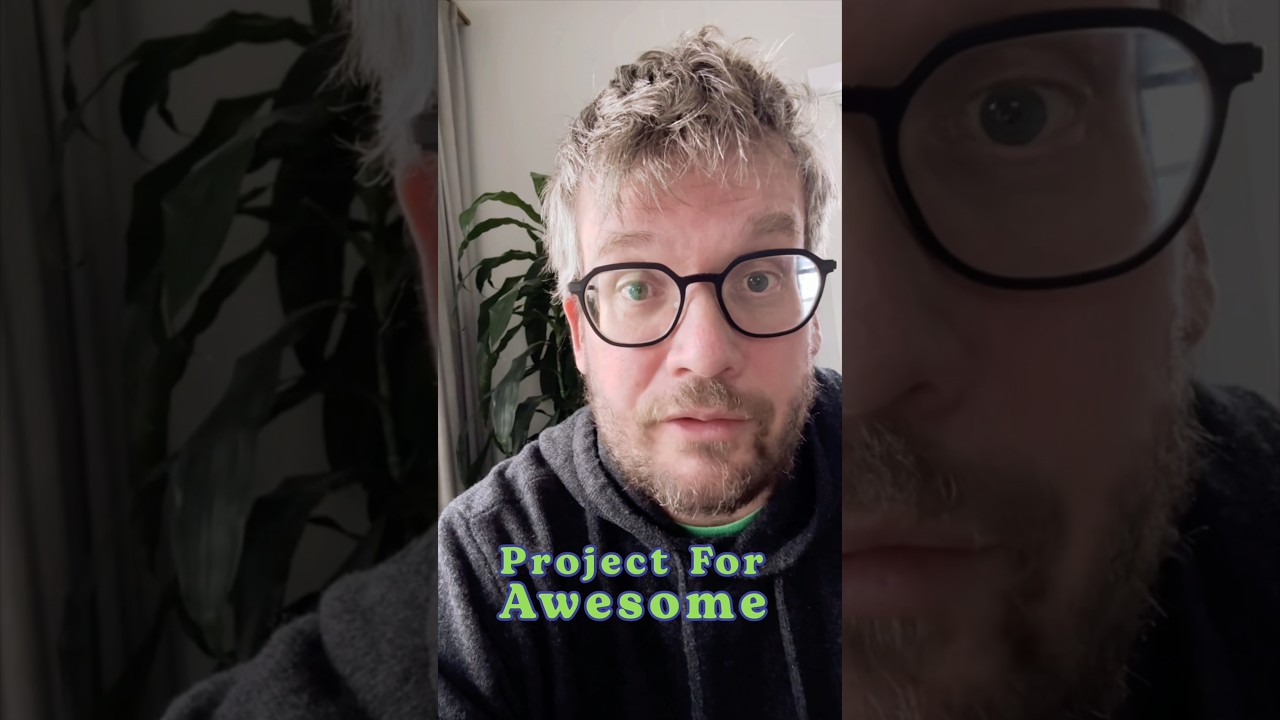
One week before the February 2026 livestream, Hank Green posted this countdown. The audience already had it on the calendar.
The Project for Awesome is the longest-running scheduled YouTube event nobody at Brandcast mentioned. The platform has been the venue for premiere weekends since 2007, and the deck that went up at Lincoln Center this May treated the format as a 2026 innovation. The innovation, from where the brothers are sitting, is that the press release finally caught up to the calendar.
2. The One That Sounds Like an Annual Ceremony
Every December for eleven straight years, Marques Brownlee has released the MKBHD Smartphone Awards. Same channel. Same broad rhythm. Same approximate spot in the calendar - early December, when the year's flagship phones are all out and the holiday-shopping question is at its loudest. The 2025 edition dropped on December 8 and ran almost twenty minutes. Brownlee's channel is now well past 20 million subscribers; the Smartphone Awards series is, by any reasonable measure, the tech community's December tradition.
What makes it appointment viewing is that it does not pretend to be a review. The reviews already happened, video by video, all year. The Smartphone Awards is the ceremony. The categories are chosen in advance. The envelopes - yes, there are envelopes - are opened on camera. People who have followed the channel for years know which phones Brownlee will pick. The pleasure of the video is not the verdict. The pleasure is being in the room when the verdict gets read aloud.

The eleventh consecutive year of the Smartphone Awards. December has its envelopes. The room has its category for Best Camera System.
This is what an annual primetime slot looks like before anybody calls it that. The audience knew it was coming. The phones being compared were the phones the audience already owned, or wanted, or had refused to buy. The acceptance speech is not from a phone executive. It is from Marques Brownlee, in his studio, holding a small glass trophy in front of a camera, telling several million people that the camera comparison was closer than it looked. Tech YouTube has had a December ceremony for over a decade. Brandcast just put a slot on June 17.
3. The One That Sounds Like a Viral Wave
And then there is the kind of premiere that nobody announced and everybody attended. In August 2022, a six-year-old named Tariq sat down with Julian Shapiro-Barnum, the host of Recess Therapy, and described corn as a big lump with knobs. The Gregory Brothers, who have spent years remixing news clips into songs, took the clip, autotuned it, and put up It's Corn - Songify This on their schmoyoho channel. The song crossed over from YouTube to TikTok to network late-night television in something like a week.
That was not a scheduled premiere. There was no countdown timer. There was no press release. There was, instead, the other kind of YouTube room: the kind that fills up after the fact, because everybody you know is suddenly humming the same chorus and you want to know what they are humming about. The room was not at premiere time. The room was wherever you happened to be when somebody texted you the link. Then it was wherever you happened to be when the algorithm caught up to the wave and started handing you the song unbidden. By the second week, the room was everyone.

No premiere date. No 8 PM slot. A six-year-old described corn as a big lump with knobs and a room of a hundred million strangers heard about it within a week.
The Recess Therapy audience that scaled to put Julian Shapiro-Barnum in a Brandcast deck four years later is the audience that gathered around that corn song. It was not gathering on a schedule. It was gathering on a wave. And the audience that gathered on the wave is now the audience YouTube is selling against for the 8 PM ET June 17 premiere of Outside Tonight. The room was there. The room was just gathering by a different mechanism.
YouTube did not bring the premiere back. The premiere never left. The platform just finally agreed it was a premiere, and put it on the deck.
The Room Gathers in Three Different Ways
What appointment viewing on YouTube has actually looked like, for the last decade and a half, is three patterns running in parallel. The scheduled telethon (P4A). The annual ceremony (Smartphone Awards). The viral wave (It's Corn). Each one is a different shape of room. Each one gathers a different kind of stranger. Each one has been doing the work the Brandcast deck is now claiming as a new format.
The chart below is one way of seeing how scheduled-room behaviors compare. The numbers underneath the rows come from public sources: the P4A Wikipedia entry for the totals, the YouTube Brandcast 2026 blog for the slate count, and the time stamps on the corresponding YouTube videos themselves.
How Long the Audience Has Been Gathering
Years a scheduled YouTube ritual existed before Brandcast called it pilot season
Sources: Wikipedia (Project for Awesome, Recess Therapy), the MKBHD channel back catalog, the YouTube Premieres feature launch announcement, and the YouTube Brandcast 2026 blog. Bars scaled so that 19 years fills the chart width.
The bar at the top is the audience YouTube has been gathering, on a schedule, in a livestream, since the year the iPhone was a few months old. The bar at the bottom is the Brandcast deck. The implication of the chart is not that Brandcast was wrong. The implication is that Brandcast was late. The pilot-season language is the formal version of what nineteen-year-old habits already proved.
Two Ways the Room Used to Gather
The TV premiere had a specific shape and the YouTube premiere has a different specific shape, and most of the discussion of YouTube-as-TV elides the difference. The table below is one way of holding them side by side. The TV column is the room I grew up with. The YouTube column is the room I gather in now.
The room on the right is not the same room as the room on the left. The room on the right is more porous - you can show up late, you can leave early, the video is still there at 11 PM if you missed the 8 PM. But the room on the right has one thing the room on the left did not. It has the chat. It has the donation counter ticking up. It has the refresh-at-7:58 ritual. The reason YouTube is selling June 17 at 8 PM ET as a premiere slot is that the platform finally figured out the room is what the advertiser is buying. Not the video. The room around the video.
What I Think You Should Do
Ethan made the structural case this morning. He is right. The Brandcast slate is a real shift, and his timeline from 2005 to 2029 is the cleanest map I have seen of how YouTube ended up at Lincoln Center.
The thing I keep wanting to say next to his case is that the audience for the slate is not new. The audience was here. The audience has been here, on its own appointment-viewing rhythm, doing scheduled gathering on a platform that for most of its life pretended scheduled gathering was beneath it. The Project for Awesome donors who set February 2026 on their calendar in October 2025. The Smartphone Awards viewers who already had a guess for Best Camera System before December 8. The corn-song listeners who showed up by accident and then never let the chorus out of their heads.
On June 17 at 8 PM ET, several million people will open the same browser tab at the same time to watch a kid-interview creator they have been following since 2021 debut his late-night format. The mechanism will feel new. The room will not. The room was here. The room has been here. The premiere was always in this house. The press release just finally arrived.
If you have a YouTube channel, you have probably already done a version of appointment viewing. You have probably noticed that some videos land harder when you release them on a specific day. You have probably noticed that the comment section under those videos looks different - more people saying I was waiting for this, more people saying I set the notification. That is your room. Brandcast did not invent it. The slate did not invent it. The platform finally has a press release for what your audience has been quietly doing for you the whole time.
Tonight, if a creator you have followed for years posts something at a time you can be there - go be there. Open the chat. Read it scroll past. Stay through the livestream. Let the wait be part of the gift. The room is small enough that the creator can sometimes see who is in it. The room is large enough that you will not be the only person who waited. That is what a premiere has always been. The wait is the whole shape of the gathering. YouTube did not invent it tonight. YouTube just finally said so.
Join the conversation