
The Audio Was Removed for Copyright. The Comments Still Know What It Was.

It is past eleven and you have gone looking for a specific video. You half-remember it from a decade ago. Somebody at a school dance, somebody's cousin's wedding, somebody mouthing the lyrics in their bedroom mirror. You find the link. You click play. Nothing happens. The picture moves. The faces laugh. The grey notice slides across the bottom of the player. Audio removed due to copyright infringement. Whatever the song was, it is not in the video anymore.
You scroll down to the comments. Past the new ones. Past the dead links and the broken usernames. About a year and a half deep, somebody you have never met has written, in five words: RIP audio. It was Hallelujah. Two replies under that, someone else has corrected them. It was a different cover. Here is the link to the audio-only version. The link is still good.
The song is gone from the video. The song is still in the comments.
This morning, Ethan wrote about the new button YouTube just added inside Studio. Create. Click it on a copyright-claimed video and YouTube generates four AI instrumental tracks, mood-matched to the footage, that you can drop in over the silence. No re-upload. No revenue share. The claim dissolves. The video resumes. Where there used to be either the original song or the polite grey banner, there is now something. Something is the operative word. It plays. It does not sound like nothing. It also does not sound like what was there. His piece is about what that change costs the music industry, which built a twelve-billion-dollar arrangement on top of those polite grey banners. The thing I want to add tonight is what it costs us. The people who, until the Create button arrived, had two options for what the song could be doing in the video: playing, or missing. Now there is a third option, and it is harder to feel than either of the others.
The Era of the Polite Grey Banner
For most of YouTube's life, the song in a personal video had two possible fates. It could be cleared, which mostly happened to the people uploading songs on purpose. Or it could be matched by Content ID, the system YouTube launched in October 2007, and quietly removed - leaving the rest of the video, the faces, the dancing, the candles on the cake, playing in absolute silence with a polite grey banner across the bottom.
If you grew up on early YouTube, you knew the banner. It sat under the wedding montage your aunt uploaded with Vitamin C's Graduation (Friends Forever) running underneath. It sat under the high school senior video set to Coldplay. It sat under the recital your mom recorded in a church basement and posted for her sister in another country to see. The video was there. The picture moved. The song, the part she had picked specifically because of what it meant in that room on that night, was gone.
Almost nobody disputed it. The dispute form was hidden under three submenus, the language was scary, and ordinary people uploading their own home footage assumed that the platform had to be right because the platform was the platform. So the song stayed gone. Multiply by twenty years of weddings, prom videos, baby montages, anniversary slideshows, talent show clips, and karaoke night recordings, and you arrive at a quiet, very large landscape of muted personal history that nobody made a feature for.
The polite grey banner was the first time most people learned that a personal memory could be removed from a personal video. It was the moment the upload stopped being theirs and started being a licensable use of a song they had already paid for once, in a shop, on a CD, in 2003.
What softened that landscape, in the late 2000s, was an unusual decision. Sometimes, instead of muting the audio, the rights holder chose to leave the song in and run an ad against it. The most famous early case was the JK Wedding Entrance Dance in July 2009 - a Saint Paul couple, Jill Peterson and Kevin Heinz, processing down the aisle to Chris Brown's Forever while their entire wedding party did a full choreographed sequence. The video crossed three and a half million views in its first forty-eight hours. Sony, who held the rights to Forever, did not mute it. They monetized it. The song, which was already a year old, climbed back to number four on iTunes and number three on Amazon's MP3 chart in the weeks after the wedding video went up. The couple set up a donation page for the Sheila Wellstone Institute - the song's writer was in the news for very different reasons that summer - and raised sixteen thousand dollars in two months.
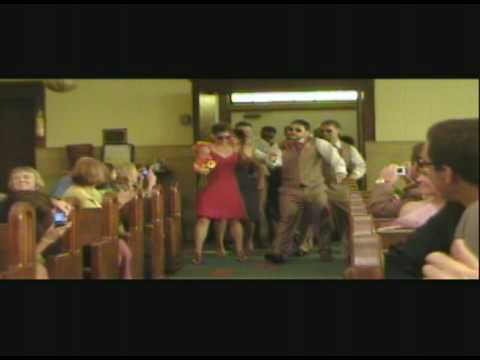
The video Sony chose to monetize instead of mute. The song stayed. Sixteen years later, the audio is still the audio. The couple are still married. The link still works.
That case became a template. Through the 2010s, the labels figured out it was usually better to keep the song in and take a cut of the ads. The polite grey banner became less common on famous uploads. But on the long tail - the family videos, the personal channels, the things uploaded by people who had no idea their ten seconds of Hallelujah were even a copyright question - the song still came off. And on those videos, the comments became the place the song lived.
Three Things That Can Happen to the Song
From this month onwards, the song in a copyright-claimed video has three possible fates instead of two. The chart below is a sketch of the eras. The first column is roughly how long each era has been the dominant treatment for ordinary uploads. The shape is not a value judgement; it is just the rough length of time each option was the default.
How Long Each Era Was the Default
What YouTube did to the song in your personal upload, by era
Sources: YouTube blog (Content ID launch October 2007), Wikipedia JK Wedding Entrance Dance (Sony monetization decision July 2009), Music Business Worldwide ($12B cumulative payouts through 2024), YouTube Creator Insider (Create button rollout, May 2026). Bars scaled to the longest era.
The eras did not have neat edges in real life. Plenty of muting still happens. Plenty of monetizing did happen before 2009. But that is the rough story. Most of the personal videos with copyrighted songs that you have ever opened, watched, lost, and tried to find again sit somewhere on that long pink bar in the middle. Some of them are muted. Some of them are still playing the original song with an ad in front. None of them, until this month, had ever heard their own song replaced by a track that almost-but-not-quite fits the footage.
What Gets Remembered When the Song Goes
The most underrated thing about a song in a personal video is what it was doing for the upload before the rights holder noticed. The song was not background. The song was the date. The song told you which year the video was. The song told you what age the people in the video were. The song told you what the room had been like that night, what station was on, what was playing on somebody's iPod through a speaker on the kitchen counter.
When the song is removed, the video does not get worse. The video gets vaguer. The faces are still the same faces. The dance is still the same dance. But the year goes. The room goes. The reason this specific song was on at this specific moment goes. The polite grey banner takes the meaning with it and leaves the picture.
The comments are where the meaning went. Tom Scott's 2020 video on YouTube's copyright system ended with a line that has been quoted back at the platform many times since: YouTube's copyright system isn't broken. The world's is. He was making a careful, lawyerly argument about why the rules YouTube has built are mostly the best available response to a copyright regime designed for a different century. But the line stayed with people for a softer reason. It described a thing the people in the comments under muted videos had always known. The system is doing what it is supposed to do. The thing that hurts is not the system. The thing that hurts is what the system is enforcing, on a video that was never going to compete with a record label, made by a mother in a basement, in 2009, for an audience of one in another country.

A nineteen-minute lawyer-careful argument that the rules YouTube built were mostly the best available response to a broken copyright regime. The line in the title is the one that stuck.
Under those muted family videos, the comments are usually shaped like a relay. Somebody arrives, watches the silent footage, and asks what was the song. Somebody else, sometimes years later, answers. The answer is rarely a guess. The answer is usually the title, the artist, and a link to a still-up audio-only version on a different channel. Sometimes there is a memory attached. I had this on a mix CD that summer. This was the song at my own wedding two months later. I don't know these people but I cried for a minute when I heard it again. The platform took the audio out. The audience put it back, in writing, underneath.
Three States. Three Different Things to Mourn or Not Mourn.
Starting this month, the song can be in a third state, and the third state is the strangest one. The original song is gone. The polite grey banner is gone. In place of both, an AI-generated instrumental, mood-matched to the picture, plays underneath. The video is no longer silent. The video is also not the video you uploaded. The table below is a way to hold the three states next to each other.
The third column is the new column. It is the easy one to choose. The Create button removes the grey banner and the dispute screen and the headache. The video is no longer a problem inside Studio. The uploader is, in a quiet, technical sense, made whole. But the column also describes a thing the other two columns do not describe. The silence under an old wedding video says something honest. It says, the song was here, and now it is not, and you can ask the comments what it was. The AI replacement does not say that. The AI replacement does not know to say that. It plays.
What I Think You Should Do
Ethan made the structural case this morning, and it is the right one. The new tool routes a twelve-billion-dollar music industry settlement around itself. It changes the maths of Content ID. It is a serious feature.
The thing I want to add is for the rest of us, again. The ones who never uploaded anything Content ID would ever notice, but who have a folder on a hard drive somewhere of family videos we keep meaning to upload, and who have watched, on long evenings, a lot of silent footage of people we love.
If you have one of those old uploads, the kind that lost its song years ago, you now have a choice you did not have last month. You can leave the silence and the grey banner where they are. You can let the comments keep being the song. You can let the absence stay, because the absence is honest about something that happened. Or you can open Studio, click Create, and let YouTube give you a track that fills the room with something nobody in that room ever heard. Either is a real option. Neither is automatic.
The thing that is worth doing, before you click anything, is sit with what each option is actually choosing for. The silence chooses to preserve the fact of the loss. The AI track chooses to preserve the flow of the picture. The original song, if you ever get it back, chooses to preserve the night. Three different things. The Create button is going to feel like the obvious answer because it removes friction. The other two answers are not less right. They are just less convenient.
The song is not in the video anymore. The song is in the comments now. The new tool will fill the silence with something. The thing it is filling was where the family kept the year.
Sometime tonight, somewhere on YouTube, a person you have never met is going to open a video from 2009. The picture will move. The grey banner will slide across the bottom. They will scroll to the comments. Half a paragraph in, in a sentence somebody typed at midnight in 2014, the song will be named. They will recognize it. They will sit in their kitchen, by the light of a laptop, listening, in their head, to a version of the night that was never actually on YouTube to begin with. The platform is not going to know they did that. The Create button is not going to fix it. The comments will hold what the platform can no longer play. That is, for now, where the music is.
Join the conversation