
Before the Video Plays, the Story Has Already Begun

You're scrolling YouTube sometime around midnight, not looking for anything in particular. Just scrolling. Thumbnail after thumbnail, a grid of small rectangles, each one making some kind of silent offer. And then one stops you.
Not the title. The image.
Maybe it's a face with an expression you've never quite seen before. Maybe it's a color that doesn't belong next to the others. Maybe something in the composition suggests that a moment has already happened - that you've arrived late to something important. You tap before you've had a conscious thought about why.
That's not the algorithm working. That's a story landing.
The World's Smallest Stage
A YouTube thumbnail is roughly the size of a playing card on your phone screen. Smaller when you're browsing a full homepage grid. It exists alongside dozens, sometimes hundreds, of competing images, each fighting for a fraction of a second of your attention - research suggests viewers decide whether to click in about 0.3 seconds.
In that fraction, the best thumbnails manage something genuinely difficult. Without a single word - or three at most - they tell you who this video is for, what kind of experience it will be, and whether the person behind it is worth trusting.
That last part matters more than most people realize. A thumbnail isn't just an advertisement for a video. It's the first line of a relationship.
Trust as the Hidden Ingredient
Chucky Appleby has spent years thinking about this problem. As the designer behind MrBeast's thumbnails, he's had more A/B test data than most creative directors see in a career. In a conversation with YouTube's algorithm team - captured in the Creator Insider video below - he kept returning to one word: trust.

Every insight Appleby shares here applies whether you have 100 subscribers or 100 million. The principle doesn't scale differently.
"Trust is what makes people come back and click on your videos," Appleby said in that conversation. The thumbnail doesn't just have to catch attention. It has to keep its promise.
MrBeast reportedly generates up to 20 thumbnail variations per video and tests them rigorously before settling on one. The team ran A/B tests across 30 consecutive videos and discovered that closed-mouth expressions outperformed the wide-open shock face they had been relying on. They adjusted. The formula evolved.
That kind of rigor is extraordinary. And it's also, in a way, the origin of a problem.
The Face That Ate YouTube
For most of YouTube's early life, thumbnails were an afterthought. The platform let you pick a freeze-frame from your own video - a poorly-lit mid-sentence still, a moment nobody was looking at the camera, something chosen in thirty seconds. The thumbnails looked like what they were.
Then reaction videos exploded. Then the open mouth arrived.
The logic was sound. Expressive faces read faster than text. A wide-open mouth registers as surprise, which signals novelty, which triggers curiosity. Human brains are hardwired to prioritize faces - we process them faster than almost anything else. The more exaggerated the expression, the harder it is to scroll past.
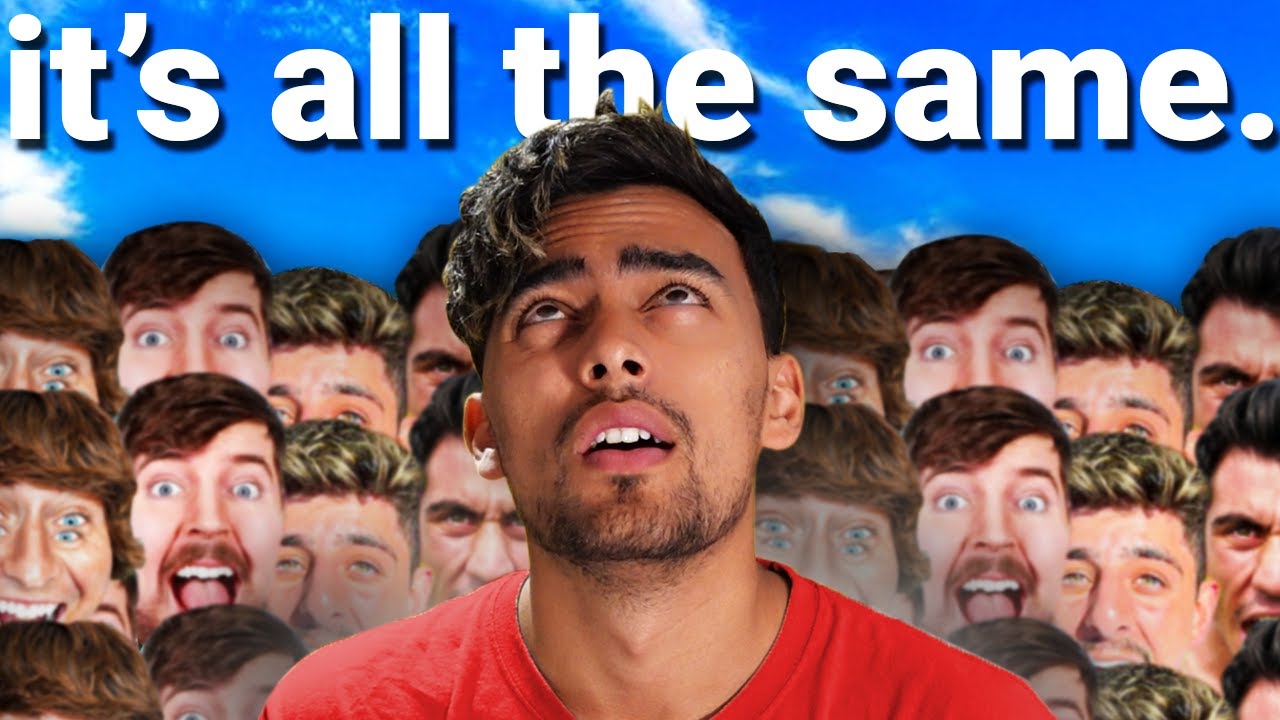
A video essay that traces exactly how one team's design choices became an entire platform's default aesthetic. Well worth an hour of your evening.
Pinely's 2023 video essay traces exactly how this aesthetic spread. One team's design choice became the visual language of a platform. The Ringer named it "YouTube Face" in a 2026 deep dive - noting that the phenomenon was so pervasive it earned its own term, and that one person was described as "the J. Robert Oppenheimer of YouTube Face."
Creators who didn't adopt the formula often found themselves invisible next to those who did. The algorithm rewarded clicks. Clicks rewarded the formula. The formula became the default.
When the Story Becomes a Slogan
The irony is that the data eventually caught up with the overuse.
By the time MrBeast's own team ran the closed-mouth A/B tests across those 30 videos, the platform had already started showing signs of saturation. Audiences hadn't stopped responding to emotion in thumbnails. They'd learned to distrust one particular performance of it.
Make your thumbnail easy to understand, so that when people look at it the first time they're saying "I know what's going on in this video, I'm going to click on it." - Chucky Appleby, MrBeast thumbnail designer
What had happened was predictable in retrospect: a storytelling device had become a template. The face stopped being a character's face and started being a genre marker. The expression stopped signaling meaning and started signaling noise. The open mouth said: something incredible happened. But after the thousandth time, what it actually said was: I need you to click on this.
Those are very different things.
What the Best Ones Still Do
The creators who have stayed interesting through all of this tend to share one quality: their thumbnails still carry a specific point of view.
Veritasium uses curiosity rather than shock - a question implied, a scale suggested, something withheld that you want to understand. National Geographic videos use color and composition as a visual argument. Long-form essayists often use a single image that raises something without answering it. The best thumbnails, in other words, are still stories. Just compressed into one frame.
A good thumbnail tells you what kind of person made this video. Not just what the video is about - what they care about, how they see the world, whether they're someone who will respect the next twenty minutes of your life. That's a lot to communicate in 0.3 seconds. The ones that manage it aren't louder than the others. They're more precise.
Ethan wrote this morning about YouTube chapters - the timestamps that help a viewer navigate a video before they've gotten there. A thumbnail is the chapter before chapter one. It sets every expectation that the video either honors or breaks. And viewers remember which creators honor them.
The next time you find yourself clicking on a video you hadn't planned to watch, pause for just a moment before it loads. Look at the thumbnail again. Ask yourself what it actually told you. What it promised. Whether it felt like the beginning of something, or just like a shout in a crowded room.
The ones that feel like the beginning of something - those are usually the ones worth staying for.
Join the conversation